
A project by Rotary Club Lagoa International to bring advanced marine technology into Algarve classrooms
December 2025: Only 5,000 Euro still required! Contact endplasticsoup@gmail.com.
🌊 Our Mission
The crystal-clear waters of the Algarve conceal a worrying reality: every day, tons of plastic waste threaten the marine life that makes our coast unique. But what if we could turn this challenge into an extraordinary educational opportunity?
Ocean Guardians is more than a marine cleanup project — it’s an educational revolution that will bring the most advanced cleaning technology directly into schools in Lagoa, creating the next generation of ocean protectors.
🎯 Goal: 5,000 euro still needed
Purpose: Purchase of a marine drone for:
- 🧹 Active cleaning of the waters of Lagoa and Portimão
- 📚 Hands-on education for local students
- 📊 Environmental monitoring with real scientific data
- 🗣️ Community awareness through tangible results
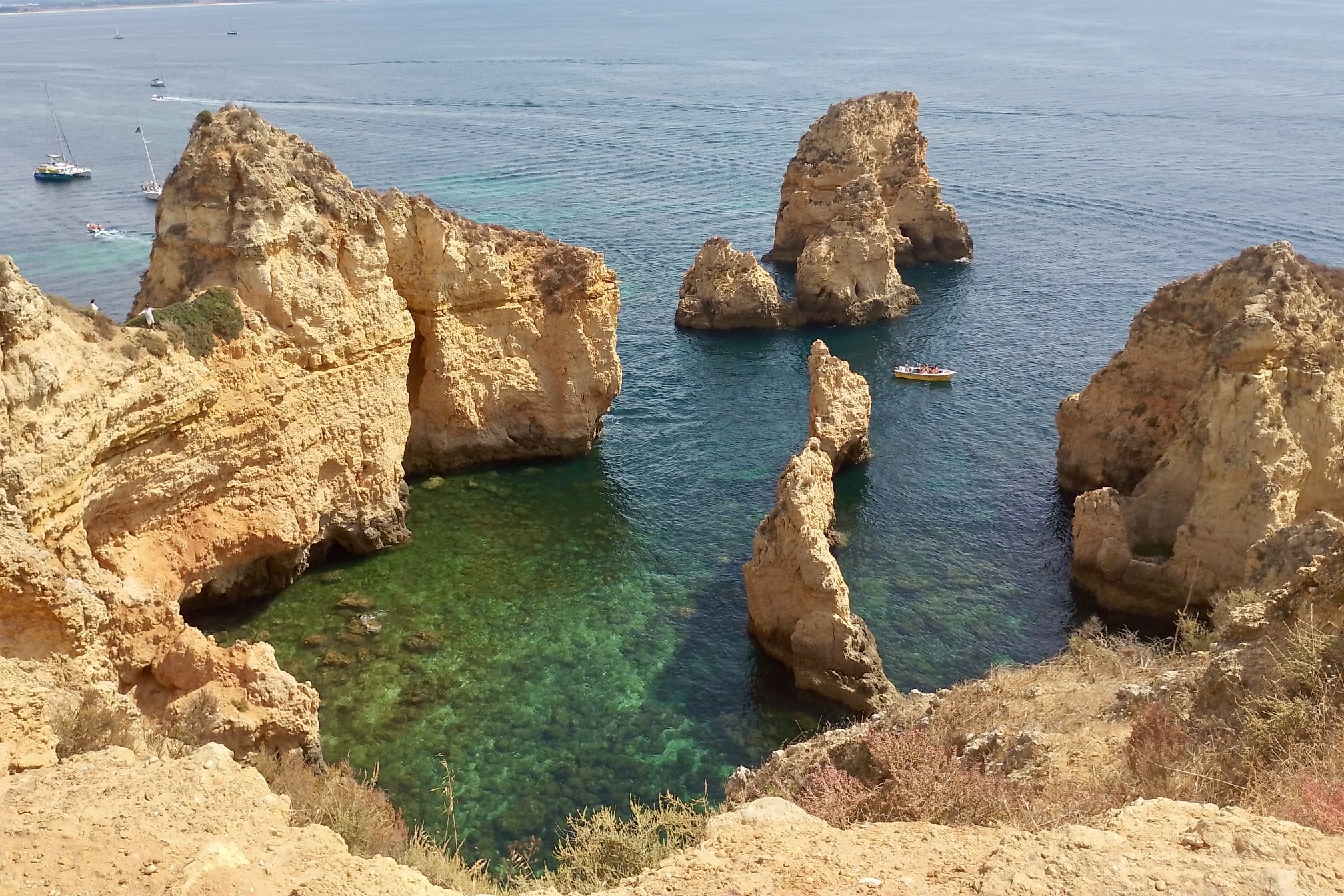
🤖 The Jellyfishbot: Technology that will change everything
Our autonomous robot isn’t just a robot — it’s a revolutionary educational and research tool
Specialized Operational Capabilities:
- 🔬 Collection of plastics and microplastics with 150µm fine nets
- 🌿 Monitoring invasive algae (Rugulopterix okamurae)
- 📊 Real-time water quality analysis (pH, salinity, temperature)
- 📡 Seafloor mapping up to 20m deep with sonar
- ⚡ 8 hours autonomy with sustainable energy
- 📱 Remote shore control, completely safe
Specific Educational Value:
- Students operate the robot under scientific supervision
- Microplastics collected are analyzed for chemistry courses
- Study of invasive algae with real quantitative data
🏫 “Future Ocean Scientists” Education
Schools in Algarve, Innovative Program by Age Group
📚 MIDDLE SCHOOL (11-14 years) – “Ocean Detectives”
- 2 sessions/month with the robot in action
- Analysis of collected microplastics using school microscopes
- Study of invasive algae and their ecosystem impact
🔬 HIGH SCHOOL (15-18 years) – “Marine Data Scientists”
- Quarterly projects monitoring algae and microplastics
- Drone piloting
- Partnership with University of Algarve (to be defined) for bathymetric data analysis
- Scientific presentations of results to families
📈 MEASURABLE IMPACT – EXPECTED RESULTS
Year 1 (2026):
- ✅ 3 tons of microplastics and marine debris analyzed
- ✅ Numerous students directly involved
- ✅ Many hours of scientific environmental education
- ✅ Weekly updated invasive algae database
Sustainable growth:
- Year 2: Expansion to other ,ocariinin algarve
- Year 3: Algarve regional network (10 schools)
📅 Timeline – From vision to reality
🚀 Crowdfunding Success (January 2026)
- Immediate order of Jellyfishbot + specialized technical configuration
- Contact and partnership with scientific organizations and schools
- Scientific protocols with University of Algarve
🏫 Research for partners and schools (September-December 2025)
- Identifying partner schools in the region
- Developing specific educational protocols
- Invasive algae database and operational setup
- Confirmation of scientific partners participation
- Confirmation of institutional support
📈 Pilot program (March 2026)
- First active schools with complete program
- First microplastic samples analyzed in labs
- Validation of educational methodologies
🌍 Legacy impact (2026-2030)
- Self-sustaining and replicable program
- Lagoa as the Portuguese model for marine education.
🎁 Rewards – Join the mission
€25 – OCEAN SUPPORTER
- 📧 Monthly updates with photos/videos
- 🏆 Numbered digital plaque “Ocean Supporter”
€50 – OCEAN GUARDIAN
- 📧 Monthly updates with photos/videos
- 🏆 Numbered digital plaque “Ocean Guardian”
€75 – MARINE EDUCATOR
- 📧 Monthly updates with photos/videos
- 🏆 Numbered digital plaque “Marine Educator”
€150 – OCEAN PROTECTOR
- 📧 Monthly updates with photos/videos
- 🏆 Numbered digital plaque “Ocean Protector”
€300 – MARINE CHAMPION
- 📧 Monthly updates with photos/videos
- 🏆 Numbered digital plaque “Marine Champion”
🌟 Support testimonials
Rotary Club Lagoa wants to show how to unite advanced marine technology and scientific education to create the next generation of ocean protectors.
Young students can finally become real marine researchers, analyzing microplastics and monitoring the ecosystem with cutting-edge tools.
“This project represents an exemplary model of how local communities can tackle marine pollution through technological education.”
📞 Questions? Full transparency
- 🌐 Website: rotary-lagoa.com/
- 📧 Email: oceanguardians@rotary-lagoa.com
- 📱 WhatsApp: +393389309140 (Response within 24h)
- 🏤 IBAN: PT50 0018 0003 5397 1412 0200 4
DOCUMENTATION:
- Detailed drone cost available
⚠️ Urgent – Why now?
🔥 CRITICAL TIME WINDOW:
School year 2025-26:
- Scientific protocols to define before autumn 2025
- Winter 2025/26: Specialized training and drone calibration
- Scientific partnerships and local institutional support: agreements to finalize by end of 2025
🌊 GROWING ENVIRONMENTAL CHALLENGE:
- Rugulopterix okamurae: +400% spread last 2 years (CCMAR)
- Microplastics: 185 particles/m² in local waters (2024 study)
- Degraded seafloors: -30% biodiversity in tourist areas (AIMM)
🔬 SCIENTIFIC VALIDATION – DATA THAT MATTERS
EFFECTIVENESS PROVEN:
- France (15 ports): -80% microplastics in 18 months (Jellyfishbot)
- School scientific programs: +85% interest in marine sciences
- Algae monitoring: results published in 3 peer-reviewed journals
ALGARVE-SPECIFIC:
- 185 microplastics/m² in coastal waters (University of Algarve 2024 study)
- Rugulopterix okamurae present in 12 of 15 monitored bays
- €1.8 million annual cost of invasive algae management (regional data)
🚀 Last call – Come on board
Lagoa can become Portugal’s beacon for sustainable marine education. But that will only happen if we act NOW, together.
- Every student we train will become a lifelong ocean ambassador.
- Every family we involve will change daily habits.
- Every piece of data we collect will contribute to global science.
The future of the ocean begins with a click.
🌊 BECOME AN OCEAN GUARDIAN TODAY
🌊 Choose your level of support and let’s unite to write a new chapter in marine protection in the Algarve.
The planet cannot wait. Neither can our youth.
Give now and transform Lagoa into the Portuguese center of marine education of the future.
💪 Who we are
ROTARY CLUB LAGOA INTERNATIONAL
- ✨ 10 years of community projects in Algarve (founded 2016, 10th anniversary 2026)
- 🌊 Official ambassadors of the End Plastic Soup program for Algarve
- 🤝 Established partnerships with local institutions
SCIENTIFIC PARTNERS (in progress):*
- CIMA – UALG: Research support and scientific validation (waiting for confirmation)*
- AIMM Portugal: Marine biology expertise (confirmed)
- A Rocha Portugal: Environmental education (waiting for confirmation)*
- End Plastic Soup Portugal (confirmed)
- IADYS: Robotic and AI (confirmed)
INSTITUTIONAL SUPPORT (in progress):
- Câmara Municipal de Lagoa: Sponsorship (waiting for confirmation )
- Marina de Lagoa: Operational base (waiting for confirmation)

About our Jellyfishbot
Main Technical and Functional Features:
- Dimensions: approximately 70 x 70 x 50 cm
- Maximum speed: approximately 2 knots (3.7 km/h)
- Power: 2 batteries providing between 6 to 17 hours of autonomy depending on the mode (autonomous or manual), recharge time between 2 and 3.5 hours
- Multidirectional propulsion (3 thrusters) allowing forward, backward, lateral movement and on-the-spot rotation
- Removable attachment system for nets and underwater sensors
- Obstacle detection and avoidance on the surface (coverage angle 270°, range 25 m) and underwater (angle 100°, range 6 m)
- Underwater sensors for bathymetric measurements up to 20 m deep
- Multidirectional onboard camera for inspection and remote piloting
- Collection: rear net with a capacity of 80 L for floating debris and 30 L for hydrocarbons and pollutants
- Connectivity: WiFi, Bluetooth, 3G, 4G, 5G, GPS
- Mission management interface and data visualization via JellyfishApp
- Materials: polyethylene and aluminum alloy for robustness and lightness
- Easy to transport and launch, intuitive to use by a single person.
The Infinite model of the Jellyfishbot is an advanced autonomous version combining remote control and autonomy with detection and avoidance of fixed obstacles both on the surface and underwater.
Its main features are:
- Autonomous cleaning of a defined area with remote control possible at any time.
- Integrated screen on the remote control showing location on map and real-time video from the onboard camera.
Onboard equipment:
- 1 HD surface camera
- GPS and inertial measurement unit (IMU)
- 1 LiDAR with a detection angle of 270° and range of 25 m for surface obstacles
- 7 underwater sonars for obstacle detection with a 6-7 m range
- 1 bathymetric probe (depths up to 20 m)
- 1 temperature probe
- Connections: 4G, WiFi, Bluetooth
- Removable attachment system for nets, booms, sensors, and complementary equipment
It maintains compact dimensions (about 70 x 70 x 50 cm), a maximum speed around 2 knots, battery autonomy up to 17 hours in autonomous mode, and collection capacities (30 L nets for hydrocarbons and 80 L for floating debris).
The Jellyfishbot is well-designed for collecting microplastics in addition to floating macrowaste. Its nets have an 80 L capacity and can capture plastic debris down to 300 microns, including microplastics. The robot can be used autonomously or by remote control to efficiently clean hard-to-access surface water areas (ports, marinas, canals, lakes, etc.).
This version is the most complete in the Jellyfishbot range, designed for long and complex missions with high autonomy and advanced operational safety.
Specific Scientific Indicators:
- Microplastics database with morphological classification
- Mapping of Rugulopterix algae with precise GPS coordinates
- Seafloor monitoring for ecosystem changes
- Student publications on local pollution impact.